 Tangkuban perahu is an active volcano, 25 kilometers north of Bandung direction of Lembang, West Java, Indonesia. Its location is in between Sagalaherang village, Sagalaherang district, Subang regency and Cikole village, Lembang district, Bandung regency. This is Bandung's most famous tourist volcano just 30 km north of the city. This volcano offers many places to see and explore. Whether we look into the huge crater or hike down into it, stroll through the forest on its slopes, or simply enjoy the splendid panoramic scenery. Mt. Tangkuban Perahu is an interesting destination that everyone in the Bandung area is fond of visiting. When seen from Bandung, Mt. Tangkuban Perahu has a distinctive shape, like an upside down boat. Tangkuban Perahu means, in fact, "up-turned boat" This peculiar shape has stimulated the fantasy of the Sundanese people from early times as expressed in the Legend of Sangkuriang.
Geologically, Mt. Tangkuban Perahu has played a significant role in the development of Parahyangan highlands. This stratovolcano is on the island of Java and last erupted in 1983. Eruptions have contributed immensely to the hills north of Bandung through lava flowing into the valleys and hardening into rock, thus forming big cliffs over which waterfalls leap. Likewise, mud flows have formed a semi-circular cone of gentle gradient (what geologists call "a fan"), which is now a mass that blocked the valley of the ancient Citarum River near present day in Padalarang (some 18 km west of Bandung), this caused a lake to form covering the whole Bandung plain.
Tangkuban Perahu
Legend of Tangkuban Perahu
 The name translates roughly to "upturning of (a) boat" or "upturned boat" in Sundanese, referring to the local legend of its creation. The story tells of "Dayang Sumbi", a beauty who lived in West Java. She cast away her son "Sangkuriang" for disobedience, and in her sadness was granted the power of eternal youth by the gods. After many years in exile, Sangkuriang decided to return to his home, long after the two had forgotten and failed to recognize each other. Sangkuriang fell in love with Dayang Sumbi and planned to marry her, only for Dayang Sumbi to recognize his birthmark just as he was about to go hunting. In order to prevent the marriage from taking place, Dayang Sumbi asked Sangkuriang to (1) build a dam on the river Citarum and (2) build a large boat to cross the river, both before the sunrise. Sangkuriang meditated and summoned mythical ogre-like creatures -buta ijo or green giant(s)- to do his bidding. Dayang Sumbi saw that the tasks were almost completed and called on her workers to spread red silk cloths east of the city, to give the impression of impending sunrise. Sangkuriang was fooled, and upon believing that he had failed, kicked the dam and the unfinished boat, resulting in severe flooding and the creation of Tangkuban perahu from the hull of the boat.
Mount Bromo
 Mount Bromo (Indonesian: Gunung Bromo), is an active volcano and part of the Tengger massif, in East Java, Indonesia. At 2,329 meters it is not the highest peak of the massif, but it is the most well known.
Bromo Tengger Semeru National Park consist of hills and mountains, with Mount Semeru (3,676m) as its highest peak. This is also the highest mountain on Java. There are also 4 lakes and 50 rivers in this national park.
It is the location of the 10-kilometre wide Tengger Caldera within which lies the Bromo Crater.
Some endangered flora are protected in this park, such as: Fagaceae, Moraceae, Sterculiaceae, Casuarina junghuhniana, Anaphalis longifolia and about 200 species of endemic orchids.
There are also about 137 species of birds, 22 species of mammals and 4 species of reptiles protected. Examples are: Accipiter virgatus, Pavo muticus, Cervus timorensis, Cuon alpinus and Panthera pardus.
Legend of Mount Bromo
 According to a folklore, at the end of the 15th century princess Roro Anteng from the Majapahit Empire started a separate principality together with her husband Joko Seger. They named it Tengger after the last syllables of their names. The principality prospered, but the ruling couple did not have children. In their despair, they climbed Mount Bromo to pray to the gods, who granted them help, but requested the last child to be sacrificed to the gods. They had 24 children, and when the 25th and last child Kesuma was born Roro Anteng refused to do the sacrifice as promised. The gods then threatened with fire and brimstone, until she finally sacrificed the child. After the child was thrown into the crater, the voice of the child ordered the local people to perform an annual ceremony on the volcano, which is still held today.
Gamelan
 Gamelan is a term for various types of orchestra played in Indonesia. It is the main element of the Indonesian traditional music. The instruments in a gamelan are composed of sets of tuned bronze gongs, gong-chimes, metallophones, drums, one or more flute, bowed and plucked string instruments, and sometimes singers. In some village gamelan, bronze is sometimes replaced by iron, wood, or bamboo. The most popular gamelan can be found in Java, and Bali.
In Indonesian traditional thinking, the gamelan is sacred and is believed to have supernatural power. Both musician and non-musicians are humble and respectful to the gamelan. Incense and flowers are often offered to the gamelan. It is believed that each instrument in the gamelan is guided by spirits. Thus, the musician have to take off their shoes when they play the gamelan. It is also forbidden to step over any instrument in a gamelan, because it might offend the spirit by doing so. Some gamelan are believed to have so much powers that playing them may exert power over nature. Others may be touched only by persons who are ritually qualified. In Javanese gamelan, the most important instrument is the Gong Ageng. The Javanese musicians believe that Gong Ageng is the main spirit of the entire gamelan.
The varieties are generally grouped geographically, with the principal division between the styles favored by the Balinese, Javanese, and Sundanese peoples. Sundanese gamelan is often associated with Gamelan Degung, a Sundanese musical ensemble that utilises a subset of modified gamelan instruments with a particular mode of pelog scale. Balinese gamelan is often associated with the virtuosity and rapid changes of tempo and dynamics of Gamelan gong kebyar, its best-known style. Other popular Balinese styles include Gamelan and kecak, also known as the "monkey chant." Javanese gamelan was largely dominated by the courts of the 19th century central Javanese rulers, each with its own style, but overall is known for a slower, more meditative style than that of Bali. In Java, gamelan music is an integral part of all cultural activities such as wayang kulit (leather puppets) performance, court dance, uyon-uyon (symphony orchestra performance), etc. There are two kinds of laras (tuning) in gamelan, namely slendro (comparable to minor key in Western music) and Pelog (major key).
The gamelan orchestra includes some singers (Pesinden), female as well as male. There are some very famous Pesindens, their names are almost known by everybody in this region. Some believe that in the ancient time, the first set of gamelan, by the name of Lokananta was created by gods and played in Mount Lawu, Eastward of Solo.
Ulos - Batak
 The most sacred textiles of the Batak people of northern Sumatra are the ragidup, was made 1900-1925, whose name literally means "pattern of life." Both during and beyond an individual's life, ragidup play central roles. Perhaps the most critical occurs when a woman is pregnant with her first child. At this time, her parents typically present her with a ragidup, which becomes, as her ulos ni tondi or "soul cloth," a supernaturally powerful object that will protect her and her family throughout life. During the rites, a specialist is called upon to "read" the cloth, whose complex patterns are believed to foretell the woman's future. A ragidup is also an essential element in Batak marriage rites, where it is wrapped around the mother of the groom by the father of the bride as a ceremonial gift. In death, the ragidup enshrouds the deceased and, years later, is used to wrap his or her bones when they are disinterred for ritual reburial.
Ragidup are constructed from five components—two side panels joined to a larger central section consisting of a large panel in the middle and two end panels adorned with complex geometric designs executed in supplementary weft (a decorative technique in which additional crosswise threads are added to the textile during weaving). In each ragidup, one end panel is considered "male" and the other "female," the gender being determined by the specific patterns used. The ornamentation of the central field varies, here consisting of a bold series of longitudinal stripes.
Songket
 Songket is a fabric that belongs to the brocade family of textiles. It is hand-woven in silk or cotton, and intricately patterned with gold or silver threads. The metallic threads stand out against the background cloth to create a shimmering effect. In the weaving process the metallic threads are inserted in between the silk or cotton weft (latitudinal) threads. Songket is a luxury product traditionally worn during ceremonial occasions as sarong, shoulder cloths or head ties. Traditionally Muslim women and adolescent girls wove songket; "some boys and men are also weaving today". Traditionally-patterned Sumatran textiles embody a system of interpretable emblems.
 In Indonesia, songket is produced in Sumatra, Kalimantan, Bali, Sulawesi, Lombok and Sumbawa. Songket weaving is historically associated with areas of Malay settlement, and the production techniques could have been introduced by Arab and Indian merchants. Historically, production was located in politically significant kingdoms because of the high cost of materials; the gold thread used was originally wound with real gold leaf.
Kebaya
 The kebaya has come to symbolise a particular construction of female identity signifying traditional values and roles for women. As a symbol, the kebaya is laden with paradoxes: it has long come to symbolize the emancipation of women in Indonesia through a representation linking the kebaya to the 19th century “proto-feminist” figure of Raden A. Kartini.
Kebaya is associated with a type of blouse worn by Indonesian women in 15th or 16th century.The earliest form of Kebaya was first came from the north of the Indonesian archipelago. The clothing type began to spread to Malacca, Java, Bali, Sumatra, Borneo and Sulawesi. After hundred years of acculturation, the garments have become adjusted to local customs and culture.
Prior 1600, kebaya on Java island were considered as a sacred clothing to be worn only by members of the Javanese monarchy. During Dutch colonization of the island, European women began wearing kebaya as formal dress. During this period, kebaya, that was originally made from mori fabric, were modified with silk embroidered with colorful patterns.
In Malacca region, a different variety of kebaya is called "nyonya kebaya" wore by the Peranakan people. Nyonya kebaya dress consists of a kebaya completed with a sarong and beaded shoes (kasut manek). The nyonya kebaya gains its popularity that the dress is worn also by non-Asian people. Apart from traditional kebaya, fashion designers are looking into ways of modifying the design and making kebaya a more fashionable outfit. Casual designed kebaya can even be worn with jeans or skirts. For weddings or formal events, many designers are exploring other types of fine fabrics like laces to create a bridal kebaya.
Barong and Rangda
 Barong is probably the most well known dance. It is also another story telling dance, narrating the fight between good and evil. This dance is the classic example of Balinese way of acting out mythology, resulting in myth and history being blended into one reality. The are several versions of the Barong Dance, as Bali has an abundance of myths and legends. There is Barong Ket, Barong Asu (Dog Barong), Barong Macan (Tiger Barong), Barong Bangkal (Pig Barong), Barong Gajah (Elephant Barong) and others.
The story goes that Rangda, the mother of Erlangga, the King of Bali in the tenth century, was condemned by Erlangga's father because she practiced black magic. After she became a widow, she summoned all the evil spirits in the jungle, the leaks and the demons, to come after Erlangga. A fight occurred, but she and her black magic troops were too strong that Erlangga had to ask for the help of Barong. Barong came with Erlangga's soldiers, and fight ensued. Rangda casted a spell that made Erlangga soldiers all wanted to kill themselves, pointing their poisoned keris into their own stomachs and chests. Barong casted a spell that turned their body resistant to the sharp keris. At the end, Barong won, and Rangda ran away.
Somebody can die or get seriously injured in a Barong dance. It is said that if Rangda's spell is too strong, a weak soldier may not be able to resist it, even with the help of Barong. He may end up hurting himself with his own keris.
The masks of Barong and Rangda are considered sacred items, and before they are brought out, a priest must be present to offer blessings by sprinkling them with holy water taken from Mount Agung, and offerrings must be presented.
Kecak Dance
 Kecak a form of Balinese music drama, originated in the 1930s and is performed primarily by men. Also known as the Ramayana Monkey Chant, the piece, performed by a circle of 100 or more performers wearing checked cloth around their waists, percussively chanting "cak" and throwing up their arms, depicts a battle from the Ramayana where the monkey-like Vanara helped Prince Rama fight the evil King Ravana. However, Kecak has roots in sanghyang, a trance-inducing exorcism dance.
Kecak dance performance only at the fullmoon and the newmoon. Atmosphere is considerably different from the one of other sing and dance groups. It is overwhelmed to flitting cheer of Kecak, light of the torch, dance with the flame and power, and the stage. It is overwhelmed to fantastic atmosphere only on special night when power stays in the entire Bali.
Culture of Indonesia
 Indonesia has around 300 ethnic groups, each with cultural differences developed over centuries, and influenced by Indian, Arabic, Chinese, Malay, and European sources. Traditional Javanese and Balinese dances, for example, contain aspects of Hindu culture and mythology, as do wayang kulit (shadow puppet) performances. Textiles such as batik, ikat and songket are created across Indonesia in styles that vary by region. The most dominant influences on Indonesian architecture have traditionally been Indian; however, Chinese, Arab, and European architectural influences have been significant. Traditional sports include sepak takraw, and bull racing in Madura. In areas with a history of tribal warfare, mock fighting contests are held, such as, caci in Flores, and pasola in Sumba.
Geography of Indonesia
Indonesia is the largest archipelago in the world. The figure for the total number of islands is 17,508 according to the Indonesian Naval Hydro-Oceanographic office. These are scattered over both sides of the equator. The five largest islands are Java, Sumatra, Kalimantan (the Indonesian part of Borneo), Papua (shared with Papua New Guinea), and Sulawesi. The archipelago is on a crossroads between two oceans, the Pacific and the Indian ocean, and bridges two continents, Asia and Australia. This strategic position has always influenced the cultural, social, political and economic life of the country. The capital, Jakarta, is on Java and is the nation's largest city, followed by Surabaya, Bandung, Medan, and Semarang.
At 1,919,440 square kilometers (741,050 sq mi), Indonesia is the world's 16th-largest country in terms of land area. Its average population density is 134 people per square kilometer (347 per sq mi), 79th in the world, although Java, the world's most populous island, has a population density of 940 people per square kilometer (2,435 per sq mi). At 4,884 meters (16,024 ft), Puncak Jaya in Papua is Indonesia's highest peak, and Lake Toba in Sumatra its largest lake, with an area of 1,145 square kilometers (442 sq mi). The country's largest rivers are in Kalimantan, and include the Mahakam and Barito; such rivers are communication and transport links between the island's river settlements. The five main islands are: Sumatra, which is about 473,606 sq. km. in size; the most fertile and densely populated islands, Java/Madura, 132,107 sq. km; Kalimantan, which comprises two-thirds of the island of Borneo and measures 539,460 sq. km; Sulawesi, 189,216 sq. km; and Papua, 421,981 sq. km, which is part of the world's second largest island, New Guinea. Indonesia's other islands are smaller in size.
Indonesia's location on the edges of the Pacific, Eurasian, and Australian tectonic plates makes it the site of numerous volcanoes and frequent earthquakes. Indonesia has at least 150 active volcanoes, including Krakatoa and Tambora, both famous for their devastating eruptions in the 19th century. The eruption of the Toba supervolcano, approximately 70,000 years ago, was one of the largest eruptions ever, and a global catastrophe. Recent disasters due to seismic activity include the 2004 tsunami that killed an estimated 167,736 in northern Sumatra, and the Yogyakarta earthquake in 2006. However, volcanic ash is a major contributor to the high agricultural fertility that has historically sustained the high population densities of Java and Bali.
Lying along the equator, Indonesia has a tropical climate, with two distinct monsoonal wet and dry seasons. Average annual rainfall in the lowlands varies from 1,780–3,175 millimeters (70–125 in), and up to 6,100 millimeters (240 in) in mountainous regions. Mountainous areas—particularly in the west coast of Sumatra, West Java, Kalimantan, Sulawesi, and Papua—receive the highest rainfall. Humidity is generally high, averaging about 80%. Temperatures vary little throughout the year; the average daily temperature range of Jakarta is 26–30 °C (79–86 °F).

Satay

Known as sate in Indonesian (and pronounced similar to the English). Satay or sate is a dish consisting of diced or sliced chicken, goat, mutton, beef, pork or fish; the more authentic version uses skewers from the midrib of the coconut leaf, although bamboo skewers are often used. These are grilled or barbecued over a wood or charcoal fire, then served with various spicy seasonings. It may be served with a spicy peanut sauce dip, or peanut gravy, slivers of onions and cucumbers, and ketupat (rice cakes).
Indonesia is the home of satay, and satay is a widely renowned dish in almost all regions of Indonesia and is considered the national dish. As a result, many variations have been developed throughout the Indonesian Archipelago. The satay varients in Indonesia usually named after the region its originated, the meats, parts or ingredients its uses, also might named after the process or method of cooking.
Sate Madura
Originating on the island of Madura, near Java, is a famous variant among Indonesians. Most often made from mutton or chicken, the recipe's main characteristic is the black sauce made from Indonesian sweet soy sauce/kecap manis mixed with palm sugar (called gula jawa or "javanese sugar" in Indonesia), garlic, deep fried shallots, peanut paste, fermented "terasi" (a kind of shrimp paste), candlenut/kemiri, and salt. Sate Madura uses thinner chunks of meat than other variants. It is eaten with rice or rice cakes wrapped in banana/coconut leaves (lontong/ketupat). Raw thinly sliced shallot and plain sambal are often served as condiments.
Sate Padang
A dish from Padang and the surrounding area in West Sumatra, which is made from cow or goat offal boiled in spicy broth then grilled. Its main characteristic is a yellow sauce made from rice flour mixed with spicy offal broth, turmeric, ginger, garlic, coriander, galangal root, cumin, curry powder and salt. It is further separated into two sub-variants, the Pariaman and the Padang Panjang, which differ in taste and the composition of their yellow sauces.
Sate Ponorogo
A variant of satay originating in Ponorogo, a town in East Java. It is made from sliced marinated chicken meat, and served with a sauce made of peanuts and chilli sauce and Garnished with shredded shallots, sambal (chili paste) and lime juice. This variant is unique for the fact that each skewer contains one large piece of chicken, rather than several small slices. The meat is marinated in spices and sweet soy sauce, in a process called "bacem" and is served with rice or lontong (rice cake).. The grill is made from terracotta earthenware with a hole in one side to allow ventilation for the coals. After three months of use, the earthenware grill disintegrates, and must be replaced.
Sate Tegal
A sate of yearling or 5-month-old kid meat; the nickname for this dish in Tegal balibul is an acronym of "baru lima bulan" (just 5 months). Each kodi, or dish, contains twenty skewers, and each skewer has four chunks — two pieces of meat, one piece of fat and then another piece of meat. It is grilled over wood charcoal until it is cooked between medium and well done; however it is possible to ask for medium rare. Sometimes the fat piece can be replaced with liver or heart or kidney. This is not marinated prior to grilling. On serving, it is accompanied by sweet soya sauce (medium sweetness, slightly thinned with boiled water), sliced fresh chilli, sliced raw shallots (eschalot), quartered green tomatoes, and steamed rice, and is sometimes garnished with fried shallots.
Sate Ambal
A satay variant from Ambal, Kebumen, Central Java. This satay uses a native breed of poultry, ayam kampung. The sauce is not based on peanuts, but rather ground tempeh, chilli and spices. The chicken meat is marinated for about two hours to make the meat tastier. This satay is accompanied with ketupat.
Sate Blora
A variant originating in Blora, located in Central Java. This variant is made of chicken (meat and skin) pieces that are smaller compared to the other variants. It is normally eaten with peanut sauce, rice, and a traditional soup made of coconut milk and herbs. Sate Blora is grilled in front of buyers as they are eating. The buyers tell the vendor to stop grilling when they are finished with their meal.
Sate Banjar
A variant of satay popular in South Kalimantan, especially in the town of Banjarmasin.
Sate Makassar
From a region in Southern Sulawesi, this satay is made from beef and cow offal marinated in sour carambola sauce. It has a unique sour and spicy taste. Unlike most satays, it is served without sauce.
Sate Buntel (Wrapped Satay)
A specialty from Solo or Surakarta, Central Java. It’s made from minced beef or goat (especially meats around ribs and belly area). The minced fatty meats are wrapped by thin fat or muscle membrane and wrapped around a bamboo skewer. The size of this satay is quite large, very similar to a middle eastern kebab. After being grilled on charcoal, the meat is separated from the skewer, cut into bite-size chunks, then served in sweet soy sauce and pepper.
Sate Lilit
A satay variant from Bali, a famous tourist destination. This satay is made from minced beef, chicken, fish, pork, or even turtle meat, which is then mixed with grated coconut, thick coconut milk, lemon juice, shallots, and pepper. Wound around bamboo, sugar cane or lemon grass sticks, it is then grilled on charcoal.
Sate Pusut
A delicacy from Lombok, the neighboring island east of Bali. It is made from a mixture of minced meat (beef, chicken, or fish), shredded coconut meat, and spices. The mixture then is wrapped around a skewer and grilled over charcoal.
Sate Ampet
Another Lombok delicacy. It is made from beef, cow’s intestines and other cow’s internal organs. The sauce for sate ampet is hot and spicy, which is no surprise since the island’s name, Lombok Merah, means Red chili. The sauce is santan (coconut milk) and spices.
Sate Maranggi (Maranggi Satay)
Commonly found in Purwakarta, Cianjur and Bandung, the cities in West Java, this satay is made from beef marinated in a special paste. The two most important elements of the paste are kecombrang (Nicolaia speciosa) flower buds and ketan (sweet rice) flour. Nicola buds bring a unique aroma and a liquorice-like taste. It is served with ketan cake (jadah) or plain rice.
Sate Kambing (Goat satay)
A variant of satay popular in Java, made with goat, lamb or mutton meat. Different than other satay, sate kambing is not usually pre-seasoned or pre-cooked. Raw lamb is skewered and grilled directly on the charcoal. It is then served with sweet soy sauce, sliced shallots, and cut-up tomatoes. Since the meat is not pre-cooked, it is important to choose a very young lamb. Most famous vendor usually use lamb under three to five months old. Lamb from goat is also more popular than lamb from sheep due to milder flavor.
Sate Kerbau (Water buffalo satay)
A variant of satay popular in Kudus, where most Muslim believed that it is forbidden to eat beef in order to respect the Hindus. This satay is made with water buffalo meat. The meat is cooked first with palm sugar, coriander, cumin, and other seasoning until very tender. Some vendor choose to even grind the meat first in order to make it really tender. It is then grilled on charcoal, and the served with sauce made with coconut milk, palm sugar, and other seasoning. Traditionally, satay kerbau is served on a plate covered with teak wood leaves.
Sate Kelinci (Rabbit meat Satay)
This varient of satay is made from rabbit meat, a delicacy from Java. It is served with sliced fresh shallots (small red onion), peanut sauce, and sweet soy sauce. Rabbit satay usually can be found in mountainous tourist region in Java where locals breed rabbit for its meat, such as Lembang in West Java, Kaliurang in Yogyakarta, Bandungan and Tawangmangu resort in Central Java, also Telaga Sarangan in East Java.
Sate Burung Ayam-ayaman (Bird Satay)
The satay is made from gizzard, liver, and intestines of “Burung Ayam-ayaman” (a migrating sea bird). After being seasoned with mild spices and stuck on a skewer, this bird’s internal organs aren’t grilled, but are deep fried in cooking oil instead.
Sate Bandeng (Milkfish Satay)
A unique delicacy from Banten. It is a satay made from boneless “Bandeng” (milkfish). The seasoned spicy milkfish meat is separated from the small bones, then placed back into the milkfish skin, clipped by a bamboo stick, and grilled over charcoal.
Sate Belut (Eel Satay)
Another Lombok rare delicacy. It is made from belut, a native small eel commonly found in watery rice paddies in Indonesia. A seasoned eel is skewered and wrapped around each skewer, then grilled over charcoal fire. So each skewer contains an individual small eel.
Sate Kuda (Horse meat Satay)
Locally known as “Sate Jaran”, this is made from horse meat, a delicacy from Yogyakarta. It is served with sliced fresh shallots (small red onion), pepper, and sweet soy sauce.
Sate Bulus (Turtle Satay)
Another rare delicacy from Yogyakarta. It is a satay made from freshwater “Bulus” (softshell turtle). It is served with sliced fresh shallots (small red onion), pepper, and sweet soy sauce. Bulus meat is also served in soup or Tongseng (Javanese style spicy-sweet soup).
Sate Ular (Snake Satay)
A rare and exotic delicacy usually founds in foodstalls specialize on serving exotic meats like snakes and lizzards, such as the one founds near Gubeng train station in Surabaya, or near Mangga Besar and Tebet train station in Jakarta. Its usually uses ular sedok (cobra) or sanca (python) meat. It is served with sliced fresh shallots (small red onion), pickles, pepper, and sweet soy sauce.
Sate Babi (Pork Satay)
A popular delicacy among the Indonesian Chinese community, most of whom do not share the Muslim prohibition against pork. This dish can be found in Chinatowns in Indonesian cities, especially around Glodok, Pecenongan, and Senen in the Jakarta area.
Sate Kulit (Skin Satay)
Found in Sumatra, this is a crisp satay made from marinated chicken skin.
Sate Telor Muda (Young egg Satay)
This satay is made from immature chicken egg (uritan) obtained upon slaughtering the hens. The immature eggs are boiled and put into skewers to be grilled as satay.
Sate Torpedo (Testicles Satay)
Satay made from goat testicles marinated in soy sauce and grilled. It is eaten with peanut sauce, pickles, and hot white rice.
Sate Ati (Liver Satay)
The satay is made from chicken liver, gizzard, and intestines. After seasoning, the internal organs are not fried or grilled, but are boiled instead. It’s not treated as a main dish, but often as a side dish to accompany Bubur Ayam (chicken rice porridge).
Sate Susu (Milky Satay)
A tasty dish commonly found in Java and Bali, made from grilled spicy beef brisket with a distinctive milky taste, served with hot chilli sauce.
The Staple Food of Many Indonesian
 Rice is the staple food of many Indonesian. We eat rice as the main dish for breakfast, lunch, and dinner. For many Indonesian, if they haven't rice yet, they don't feel like they have eaten. There is a joke that says, even if you have eaten a loaf of bread, you are still hungry. It's gotta be rice! Other Indonesians are fine with bread or noodles.
Indonesians eat rice a lot. Our breakfast is usually fried rice (nasi goreng), ketupat (rice steamed in woven packets of coconut fronds) with tahu (tofu) and sauce or yellow rice (nasi kuning) with some of side dishes. You can buy this food in every corner of the city, at the market, or by street side vendors, very early in the morning. Don't go later than 8 o'clock in the morning, most of them are sold out. Especially if they're good. For Lunch, you'll see people with a plate full with rice and a piece of chicken, or fish, or eggs and "sambal" (chillie sauce). Indonesians like to eat hot (as in spicy) food. I mean really really really HOT. I would say it is hotter than Mexican food. 
Each area in Indonesia has its own traditional food and custom. Here is a list of some of them.
* Sundanese ("orang Sunda") in West Java likes to eat fresh vegetables and sambal. Sundanese like to drink tea without sugar. So don't be surprised when they offer you tea but not sweat. Ask for sugar.
* Javanese likes to eat sweet. Tea will be sweet.
* Padang (West Sumatra) likes to eat hot/spicy food. They are famous for their spicy food and fast delivery. The waiter can bring dozens of plates with various dishes with his two hands (like juggling) in one trip. You'll eat whatever you like and at the end of meal the waiter will calculate the price. You'll find "Rumah Makan Padang" (Padang restaurant) everywhere in Indonesia.
Soto
 Soto, sroto, tauto or coto is a common dish to be found in various regional variations of Indonesian cuisine. Soto comes from the little isle of Madura (a part of the Province of East Java). It is a soup mainly composed of broth, meat and vegetables.
The meats that are most commonly used are chicken and beef, but there are also variations with offal, mutton, water buffalo meat and pork. The soup is usually accompanied by rice or compressed rice cakes (ketupat or buras). Sotos are commonly differentiated by the meat ingredient in them, e.g. soto ayam (chicken soto) and soto daging (beef soto). Offal is a very common ingredient in soto, and is considered as a delicacy: the rumen (blanket/flat/smooth tripe), reticulum (honeycomb and pocket tripe), omasum (book/bible/leaf tripe) and the intestines are all eaten.
Other ingredients of soto include soon alternatively spelled as sohun (rice vermicelli), mung bean sprouts and scallion.
Soto spices include the following: shallot, garlic, turmeric root, galangal, ginger, coriander, salt and pepper.
Yogyanese, Solonese, and Madurese soto gravy is clear; while other famous soto producers of Kudus, Sokaraja, and Surabaya make theirs thick with coconut milk.
Another way to classify sotos is by their regional style. Many metropolitan areas have their own regional soto versions:
* Betawi soto, made of beef or beef offal, cooked in a whitish cow milk or coconut milk broth, with fried potato and tomato.
* Bandung soto, a clear beef soto with daikon pieces.
* Medan soto, a milky chicken soto, with the chicken pieces fried before being mixed with the other ingredients.
* Banjar soto, spiced with lemongrass and sour hot sambal, accompanied with potato cakes.
* Makassar soto or coto Makassar, a beef and offal soto boiled in water used to wash rice, with fried peanut.
* Madura soto or soto Sulung/soto Ambengan, made with either chicken, beef or offal, in a yellowish transparent broth.
* Semarang soto, a chicken soto spiced with candlenut and often eaten with sate kerang (cockles on a stick)
* Kudus soto, made with water buffalo meat due to local taboos of the consumption of beef.
* Lamongan soto, a popular street food in various Indonesian metropolitan areas, a variation of the Madura soto.
* Pekalongan soto or tauto Pekalongan, spiced with tauco (a fermented miso-like bean paste).
* Banyumas soto or sroto Banyumas, made special by its peanut sambal.
The following accompaniments are often eaten alongside soto.
* Stewed quail eggs or chicken eggs
* Cockles on a stick (sate kerang)
* Fried chicken giblets
* Prawn crackers, sometimes crushed and mixed with crushed fried garlic as koya in Madura soto
* Gnetum seed crackers (emping)
* Fried tofu or tempeh
* Potato cakes (perkedel)
Condiments common to soto dishes include hot chili sauce (sambal), sweet soy sauce, fried shallot and lime.
Telaga Sunyi - Baturaden, Purwokerto, Jawa Tengah

Telaga Sunyi (sunyi = silent, telaga = lake) is about 3 km eastern side of Lokawisata Baturaden. One of the tourist attraction in Baturaden is this small lake. This lake not too popular, some part due to the danger (we can't swim, incase suddenly it rains and the water flooded) and some mystical belief on locals.
The lake is small and quiet as it named after, the water is clear dark green and black because of the stone below. It has a small waterfall which falls into the lake. From the lake, the stones cascaded down and forms some steep riverbanks. Along the lake there is a man-made drain full of fresh, clear, cold water from the spring.
Borobudur
 One of the 7 wonders in the ancient world, Borobudur is located near Magelang, Central Java, Indonesia. Borobudur, a Hindu Buddhist temple, was built in the 8th and 9th centuries A.D. Borobudur—the world's largest Buddhist temple. The origins of the name Borobudur however are unclear, although the original names of most ancient Indonesian temples are no longer known. The name Borobudur was first written in Sir Thomas Raffles' book on Javan history. The monument comprises six square platforms topped by three circular platforms, and is decorated with 2,672 relief panels and 504 Buddha statues. A main dome, located at the center of the top platform, is surrounded by 72 Buddha statues seated inside perforated stupa.
 The monument is both a shrine to the Lord Buddha and a place for Buddhist pilgrimage. The journey for pilgrims begins at the base of the monument and follows a path circumambulating the monument while ascending to the top through the three levels of Buddhist cosmology, namely Kāmadhātu (the world of desire), Rupadhatu (the world of forms) and Arupadhatu (the world of formlessness). During the journey the monument guides the pilgrims through a system of stairways and corridors with 1,460 narrative relief panels on the wall and the balustrades.
Following the major 1973 renovation funded by UNESCO, Borobudur is once again used as a place of worship and pilgrimage. Once a year, during the full moon in May or June, Buddhists in Indonesia observe Vesak (Indonesian: Waisak) day commemorating the birth, death, and the time when Siddhārtha Gautama attained the highest wisdom to become the Buddha Shakyamuni. Vesak is an official national holiday in Indonesia and the ceremony is centered at the three Buddhist temples by walking from Mendut to Pawon and ending at Borobudur.
Bali Island
Bali is an Indonesian island lying between Java to the west and Lombok to the east. It is one of the country's 33 provinces with the provincial capital at Denpasar towards the south of the island. With a population recorded as 3,151,000 in 2005, the island is home to the vast majority of Indonesia's small Hindu minority. 93.18% of Bali's population adheres to Balinese Hinduism, while most of the remainder follow Islam. It is also the largest tourist destination in the country and is renowned for its highly developed arts, including dance, sculpture, painting, leather, metalworking and music.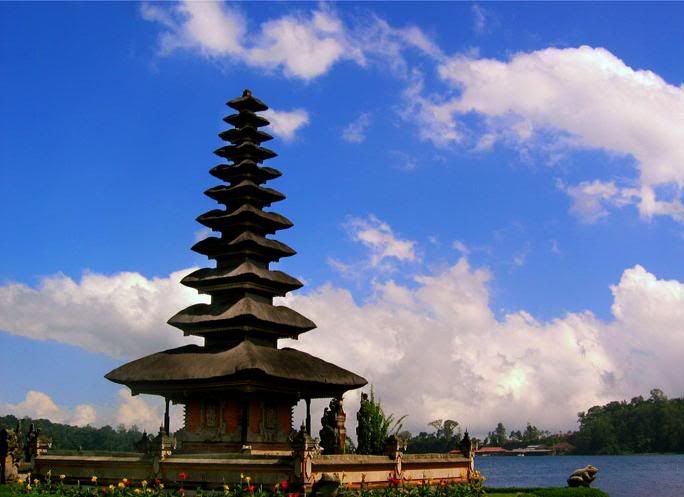
Balinese culture was strongly influenced by Indian and Chinese, and particularly Hindu culture, in a process beginning around the 1st century AD. The name Bali dwipa ("Bali island") has been discovered from various inscriptions, including the Blanjong charter issued by Sri Kesari Warmadewa in 913 AD and mentioning Walidwipa. It was during this time that the complex irrigation system subak was developed to grow rice. Some religious and cultural traditions still in existence today can be traced back to this period. The Hindu Majapahit Empire (1293–1520 AD) on eastern Java founded a Balinese colony in 1343. When the empire declined, there was an exodus of intellectuals, artists, priests and musicians from Java to Bali in the 15th century.
The principal city is the present provincial capital and largest city, Denpasar, near the southern coast. Bali's second-largest city is the old colonial capital, Singaraja, which is located on the north coast. Other important cities include the beach resort, Kuta, which is practically part of Denpasar's urban area; and Ubud, which is north of Denpasar, and known as the island's cultural centre.
The highest point is Mount Agung at 3,142 m (10,308 feet) high, an active volcano that last erupted in March 1963. Mountains cover centre to the eastern side, with Mount Agung the easternmost peak. Mount Batur (1,717 m) is also still active; an eruption 30,000 years ago was one of the largest known volcanic events on Earth.
In the south the land descends to form an alluvial plain, watered by shallow, north-south flowing rivers, drier in the dry season and overflowing during periods of heavy rain. The longest of these rivers, Sungai Ayung, is also the longest on the island (approx. 75 km).
The island is surrounded by coral reefs. Beaches in the south tend to have white sand while those in the north and west have black sand.The beach town of Padangbai in the south east has both. Black sand beaches between Pasut and Klatingdukuh are being developed for tourism, but apart from the seaside temple of Tanah Lot, they are not yet used for significant tourism.
